
How Much Does It Cost to Build a VPN App in 2026?
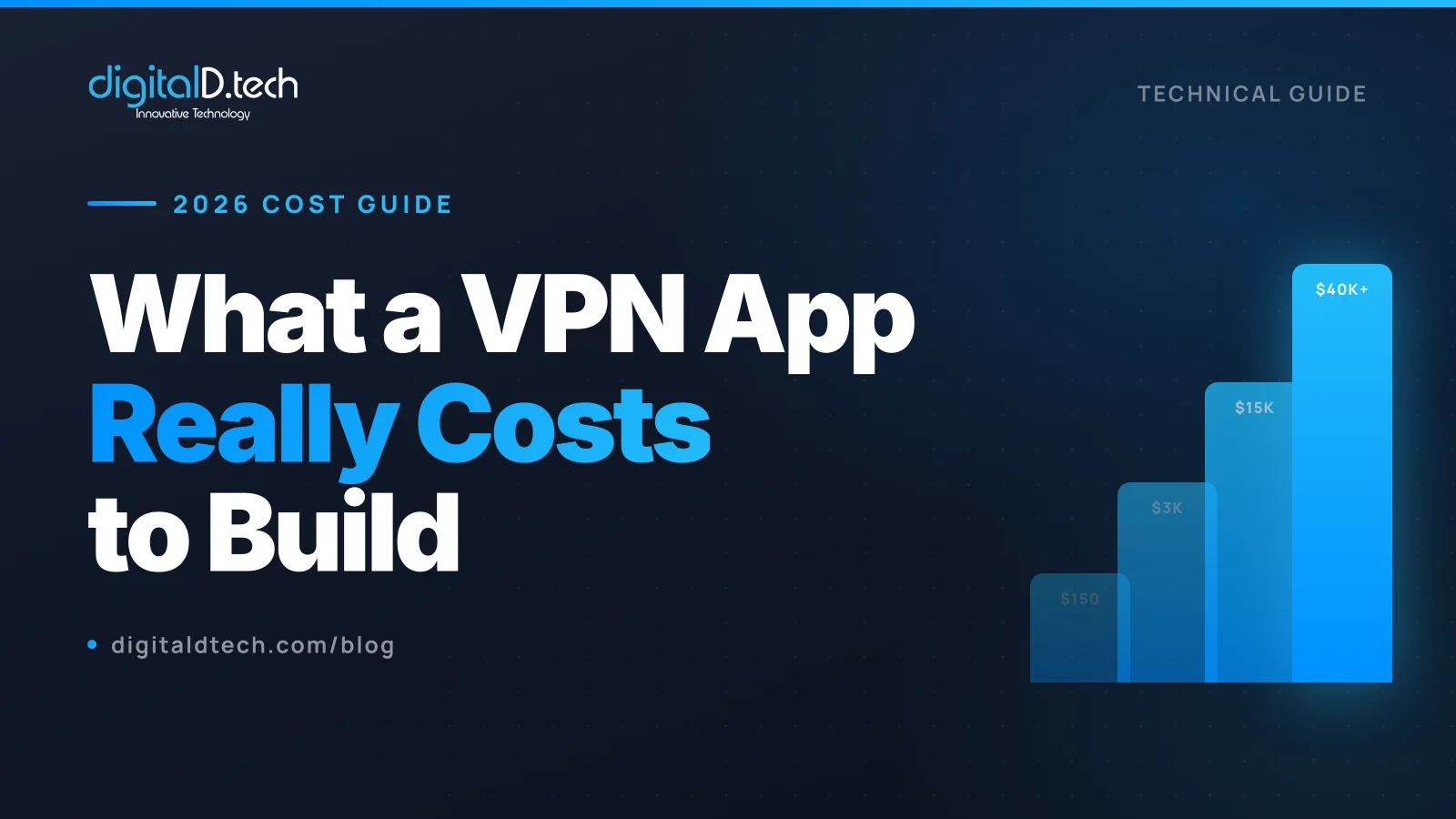
If you have searched for VPN app development pricing, you have seen numbers that make no sense together. A freelancer offers a “full VPN app with admin panel” for $150. An agency quotes $45,000 for what sounds like the same thing. Both are telling the truth, because they are describing very different products.
We build VPN apps and infrastructure, so this guide is the cost breakdown we give founders who ask. It explains what you actually get at each price point, what drives the number up or down, and the recurring costs that the build quote never mentions. The goal is for you to scope your own project well enough that no quote surprises you.
The Price Ladder, From Reskin to Production
VPN app pricing spans roughly two orders of magnitude because “VPN app” covers everything from a rebranded template pointed at a single server to a multi-protocol, multi-platform product with its own control plane. Here is how the tiers actually break down.
| Tier | Rough range | What you get | Who it suits |
|---|---|---|---|
| Marketplace reskin | $100 to $500 | A rebranded Android template, one protocol, one or a few servers, a basic panel | A demo, a quick test, throwaway validation |
| Template plus panel | $500 to $3,000 | Android (sometimes iOS) on a template, OpenVPN or WireGuard, a reseller-style panel | A small launch you plan to replace later |
| Custom multi-protocol build | $7,500 to $40,000 | Native iOS and Android, multiple protocols, real backend and billing, store submission | A brand you intend to run as a business |
| Multi-node production system | $40,000 and up | The above plus a control plane, node orchestration, monitoring, and anti-censorship work | A serious operator or a funded startup |
The marketplace floor is real. On freelance platforms you can find VPN-app gigs starting around $100 to $250, and server-setup gigs (install OpenVPN or WireGuard on your VPS) for $5 to $50. Real multi-node panel projects have been posted on freelance marketplaces with budgets of $10,000 to $20,000.
The mistake is assuming these are competing quotes for one thing. They are quotes for different things. The rest of this guide is about which thing you actually need.
What Actually Drives the Cost
Five factors move the number more than anything else. If you understand these, you can read any quote and know whether it is realistic.
Platforms: iOS is the expensive one
The single biggest cost swing is how many platforms you ship, and specifically whether you ship iOS.
Android is comparatively approachable. You build on the VpnService API, handle the system consent dialog, run a foreground service, and route packets through a virtual interface. A competent developer can get a working Android VPN client running relatively quickly, which is why the cheap marketplace gigs are almost always Android.
iOS is where budgets and timelines grow. An iOS VPN cannot simply open a tunnel. It must use Apple’s NetworkExtension framework and run inside a Packet Tunnel Provider, a separate app extension with its own process, its own lifecycle, and a tight memory budget. Apple’s documentation describes NEPacketTunnelProvider as “the principal class for a packet tunnel provider app extension,” and using it requires the com.apple.developer.networking.networkextension entitlement, which Apple grants on request. The extension runs under a constrained memory limit on iOS (Apple engineers have referenced roughly 15 MB on the Developer Forums, while noting the figure has changed before and is not a published, fixed number, so you design and test against the device rather than a documented constant). Getting reconnect logic, kill switches, and background behavior reliable across iOS versions is genuine engineering, not configuration.
So a quote for “iOS and Android” should cost meaningfully more than Android alone. If it does not, ask what the iOS side actually involves.
Protocols: the right ones, not the most
Buyers often list five or six protocols in a brief, as if more is better. It is not. The protocol set should follow your market.
For mainstream markets, WireGuard is the sensible default (fast, lean, modern cryptography), with OpenVPN or IKEv2 alongside it for compatibility. That covers most consumer and business use, and it is well-understood work.
For censored markets, the cost changes because the requirements change. Vanilla WireGuard and OpenVPN are easy for deep packet inspection to fingerprint and are commonly blocked, so you move into the proxy ecosystem: protocols like VLESS carried over an obfuscation layer such as REALITY, or QUIC-based options like Hysteria2. These are implemented by cores such as Xray-core and sing-box rather than by a classic VPN daemon, and integrating them into native mobile clients is more involved. If your product targets China, Iran, or Russia, budget for this work and for the ongoing maintenance it implies. If it does not, do not pay for protocols you will never enable.
The control panel and backend
Almost every VPN-app brief includes the phrase “with admin panel,” and buyers tend to treat the panel as a small add-on to the app. It is not. The panel and the apps are two distinct engineering tracks.
A real control plane creates and revokes user accounts, ties access to subscription status, provisions server configurations, handles billing and renewals, and (for resellers) manages multi-tenant credit. Open-source panels exist in the proxy ecosystem, but a commercial product usually needs more than a self-hosted panel’s defaults provide. This is real backend work, and it is often where a build either holds together or falls apart at scale.
The server network
Your apps connect to servers, and that network is an ongoing cost, not a build cost. You can rent capacity or run your own nodes. Either way, bandwidth (not server rental) is the line item that scales with success. A common, sensible starting point is a small set of well-connected locations rather than a “100 countries” promise on day one. Model bandwidth against realistic usage before you commit to unlimited-data marketing.
App store compliance
Both stores scrutinize VPN apps heavily, and a rejection can stall a launch for weeks. Apple Guideline 5.4 requires VPN apps to use the NEVPNManager API and to be published by a developer “enrolled as an organization,” and prohibits selling or disclosing VPN data. Google Play’s VpnService policy requires VPN to be the app’s core functionality, a policy declaration, prominent in-app disclosure of data collection, and bans manipulating other apps’ traffic. Factor review time and the possibility of rejection into the timeline, and prefer a partner with a track record of approved VPN submissions.
The Costs the Build Quote Leaves Out
The build is the beginning, not the end. Owning a VPN product carries recurring costs that founders routinely forget:
- OS updates. Each major iOS and Android release can break VPN behavior. Someone keeps the apps working, indefinitely.
- Protocol and security patches. Cores and libraries get fixes; staying current is continuous.
- Store compliance churn. Apple and Google change VPN rules; resubmissions happen.
- Anti-censorship upkeep. If you serve censored markets, blocking is an arms race. Server IPs get flagged and need rotation, and obfuscation that works today can be detected later. This is ongoing operational work, not a one-time setup.
- Infrastructure and bandwidth. These grow with your user count.
- Support. Subscription products generate support load.
A useful way to compare a custom build against a white-label fee is total cost of ownership over three years, including the team or partner who keeps the software alive, not the build quote against the monthly fee.
$150 vs $15,000: A Worked Comparison
To make the spread concrete, here is what each end of the range typically buys.
| $150 marketplace gig | $15,000 production build | |
|---|---|---|
| Platforms | Android template | Native iOS and Android |
| Protocols | One (often OpenVPN) | The right set for your market |
| Backend | Shared or minimal panel | Your own accounts, billing, provisioning |
| App store | Your problem | Submitted, with rejection handling |
| Ownership | Little to none | Your code and your data |
| Maintenance | None | Planned |
| Good for | A demo | A business |
Neither is “better” in the abstract. If you are validating whether anyone wants your VPN, the cheap gig is a rational way to test, as long as you treat it as disposable. If you are building a brand you intend to run and sell against, the cheap gig becomes the more expensive choice the moment you try to scale it.
How to Scope Your Own Build
Before you collect quotes, answer these. The answers determine the realistic cost more than any vendor does:
- Which platforms do you actually need at launch? (Be honest about iOS.)
- Which markets do you serve, and do any of them censor VPNs? (This decides your protocol stack.)
- Do you need your own billing and accounts, or can you integrate an existing subscription platform?
- Will you run your own server network, or rent capacity?
- Do you need to own the source code (for audits, fundraising, or resale), or is renting acceptable for now?
- What is your three-year user target, so you can model bandwidth and per-user costs at scale rather than at launch?
A quote that does not engage with these questions is a quote for a template, regardless of the number attached to it.
FAQ
How much does it cost to build a VPN app?
It depends almost entirely on scope. Rebranded marketplace templates start around $100 to $500, custom multi-protocol builds run from roughly $7,500 into the tens of thousands, and multi-node production systems with their own control plane and anti-censorship work start around $40,000 and up. The widest cost driver is whether you ship native iOS, which is significantly more involved than Android. Treat any single number as meaningless without a defined scope.
Why is a VPN app so much cheaper on Fiverr than from an agency?
Because they are different products. A low-cost gig is typically a rebranded Android template pointed at one or a few servers, with no real backend, no iOS engineering, and no store-compliance support. An agency build includes native apps, a real backend, the protocol set your market needs, and ongoing maintenance. The cheap option is fine for a throwaway test and expensive to scale.
Is iOS really more expensive than Android for a VPN app?
Yes, generally. iOS VPN apps must use Apple’s NetworkExtension framework and run inside a Packet Tunnel Provider extension with a constrained memory budget and a restricted entitlement, and they must be published under an organization account per Apple’s Guideline 5.4. Android’s VpnService API is more approachable, which is why most low-cost gigs are Android-only.
What ongoing costs should I budget for after the build?
OS-update maintenance, protocol and security patches, app-store compliance changes, server and bandwidth costs that scale with users, customer support, and, if you serve censored markets, continuous anti-censorship work including IP rotation. Compare total cost of ownership over three years, not just the build price.
Do I need six protocols?
Almost never. Most products need a sensible default like WireGuard plus a fallback for compatibility. Only products targeting heavily censored markets need the proxy and obfuscation stack (such as VLESS with REALITY), and that work carries real ongoing maintenance. Paying for protocols you will not enable is wasted budget.
Scope It Before You Buy It
The reason VPN app quotes vary so wildly is that the work varies wildly, and most of the variation hides in iOS, the backend, and the markets you serve. Once you can answer the scoping questions above, the price stops being mysterious.
If you want a second opinion on scope before you commit a budget, DigitalD.tech can help. We build native iOS and Android VPN apps in-house, across the full protocol range from WireGuard and OpenVPN to the anti-censorship stack (VLESS with REALITY, Hysteria2, Shadowsocks, and AmneziaWG), so we scope the work to what your market actually needs rather than pad it with protocols you will not use. The figures above are third-party market ranges, not our quote; pricing depends on your platforms, markets, and feature list, so we quote per project. If you are still deciding between building and buying, our guides on white label VPN vs custom VPN development and how to start a VPN business in 2026 cover the trade-offs, or get in touch with your platforms and target market for a quote.